Note – This is Part 5 in a series of articles highlighting unpublished documents related to Union activity on Virginia’s Northern Neck in 1863. My previous post covered an expedition in early-March led by Col. Walter Phelps and Capt. Craig Wadsworth. Their men, infantry and cavalry, were back in camp by March 9.
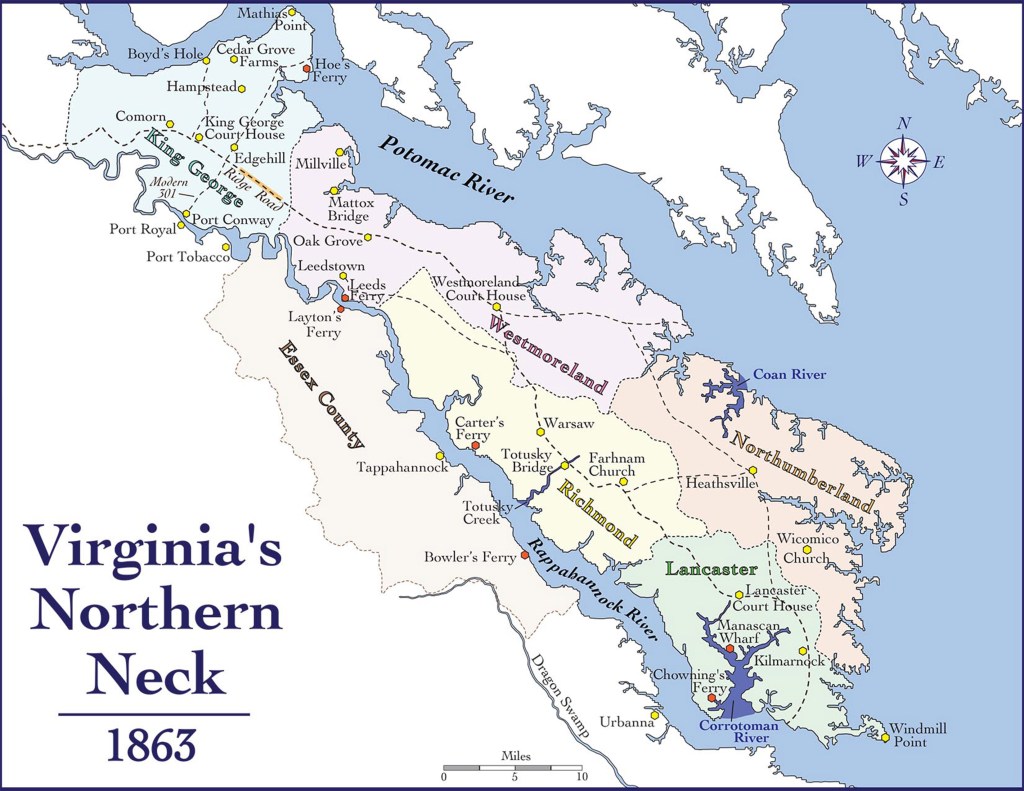
On March 17, Maj. William McEwen led a battalion from the 1st Pennsylvania down the Neck, on what the regimental historian termed a scouting mission. The men departed from King George County to an unstated point farther south or east where they destroyed “a number of barges and boats employed in smuggling contraband goods across the Rappahannock.” Two days later, Maj. James Gaston led another squadron from the regiment to Westmoreland Court House for the same purpose.
Quoting the regimental history, “On arriving at [Mattox] Creek…the party was divided: Capt. [J. H. Williams], with K company taking the road to [Mattox] Creek landing, while Capt. T. C. McGregor, with I company proceeded on toward the Court House, and returning by way of Leedstown, destroying a large boat and captured a smuggler’s wagon, loaded with silks, shoes, fancy goods and imperial tea. All that could be carried was packed on the saddles, and the balance, with the wagon, was destroyed, and the party returned next day to headquarters, having more the appearance of a travelers’ caravan, than a squadron of Yankee cavalry.”
Large scale missions appear to have then ceased for several weeks, but the Federals had not abandoned their efforts to break up the shipment of goods from the Northern Neck to General Lee’s Army of Northern Virginia. Previously, Col. George Sharpe, commanding General Hooker’s Bureau of Military Intelligence, had requested that several hand-picked soldiers be transferred to assist him. The men included sergeants Milton Cline and Daniel Cole from the 3rd Indiana. In late-February or early March both men set out, separately, passing through the Union pickets in King George County and heading down the Neck.
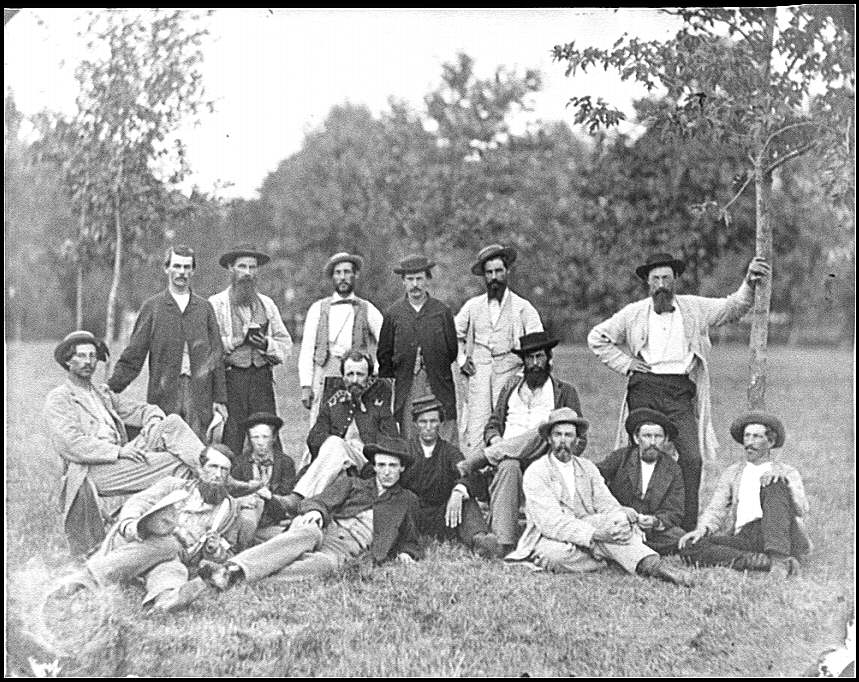
Milton Cline is believed to be the second seated man from the left, who appears to be wearing shoulder straps in this 1864 image from the Library of Congress. Daniel Cole is seated to Cline’s left with the dark hat and beard.
In his ground-breaking study, The Secret War for the Union, Edwin Fishel discusses Sergeant Cline’s journey behind enemy lines in some detail, a trip that covered 250 miles over ten days. But neither Fishel nor regimental historian James Goecker discuss Cline’s passage down the Northern Neck in any detail. Luckily, Colonel Sharpe compiled some notes in a report he titled Statement of Sergeant [Cline], 3rd Indiana Cavalry concerning Layton’s Ferry and other matters. His report, dated March 20, notes:
“The principal ferry is at Layton’s. John [Dishman] lives at Leeds, he is the father-in-law of Armstrong, who lives just above the dock at Layton’s. They have men employed … who communicate with rapidity the arrival of our cavalry as low as Oak Grove.
“Charles Jett, one of the leaders, lives on the Oak Grove and Leeds road about midway between. At Oak Grove [Goldman] and Capt. [Bauter or possibly Banter]. Charles Jett also forwards cattle for Confederate Government.
“March 16 – Saw the boats cross 3 times at Layton’s, within 2-3 hours and below there for a mile and a half saw a great number of boats crossing with forage principally.
“Some barns there with 3 years stock. 200,000 bushels fodder inside the [unreadable].
“Ned Owens oversees on the Bunker Hill farm near the ferry opposite Layton’s.
“At Tappahannock they are landing great quantities of meat and grain. Also, at Union Wharf.
“Last Tuesday night at 10 pm saw a Captain [name unreadable] of the 10th NY Cavalry at Charles Mason’s 2.5 miles from King George CH towards Potomac River, talking with Mason and Lewis Ashton and J Stewart and Lt. Jones, 9th VA, the latter officer in Confederate army about the return of some of Mason’s cattle – 2 yoke of steers and the captain promised they should be returned. Said he would send up in the morning. This must have been 2.5 miles from the U. S. Cavalry outpost.
“The Capt. left promising to go and dine with Mason the next day or day after and after he left the Confederate officers discussed the propriety of capturing him and his men, which Mason argued against, as it would be a bad thing for him and his property.
“They also talked about getting information from Roy Mason about our lines through our officers who visit him.
“A party of darkies from ‘Marmion’ started to come inside our lines within a week or 10 days past and were turned back by the 10th NY Cavalry.
“Heard Charles Jett, [Ned] Owens, Armstrong and Goldman talk about preparations to capture another squad of our cavalry.
“Dr. Stewart, near Hampstead, assisted late desertions from our army, making his Negroes exchange clothes with our soldiers who [were] then sent across the Potomac. This can be proved by Adam and other Negroes on the Cedar Grove farm. Arms and uniforms can be found there now.”
Names are often difficult to determine with accuracy. The name of the officer from the 10th New York is unreadable and I could not identify the officer in the 9th Virginia with the last names of Jones, though several troopers with that surname called the Northern Neck home. The man listed as J. Stewart and or Dr. Stewart may be Dr. R. H. Stuart mentioned in Part 1. Sharpe reiterated most of the information here in a second report a couple of days later. For more on the farm known as Marmion, see Marmion | Small But Important Riots.
Sergeant Cline crossed the Rappahannock River a few miles below Port Royal and then worked his way back north and west through the Southern camps before returning to Union lines.
Colonel Sharpe sent a more detailed report to Brig. Gen. Marsena Patrick, Hooker’s provost marshal, the following day.
“In my examination of prisoners and other agents furnishing information, my attention has lately been drawn most strongly to the question of the subsistence of the Southern army, which seems to be nearing the point of total failure.
“From a mass of testimony, that in a court of record, would authorize the judge to rule that no further evidence on that point would be received, we know that the ration of the army opposite us is – 1 pint flour and ¼ lb. bacon or pork per Diem.
“Soldiers escaped thence remember the issue of a little sugar or rice in addition to the above about once in three weeks, but all the other articles, including candles, have long since disappeared from their commissary stores. True, we have at times had other stories. The argumentative chaplain of Stewart’s Cavalry, Capt. Alexander of Lee’s Brigade [not yet identified but possibly a false name], and the other commissioned officers who have been in our custody, with a single sergeant who appears to be a man of substance, have boastfully asserted the [endurance] of their resources. They were well clad when they said so but the ragged and beggarly fellows who formed their rank and file on the other side did not so understand the ‘teacup of flour and patch of bacon,’ which was daily issued to those who are interested in the success of the rebellion.
“…we know that the Confederate Government is impressing all cereals and their right to do so is being fought out in the courts, while the Virginia legislature and the power of the Governor by proclamation have been invoked to compel the people to raise corn rather than cotton or tobacco. [For a discussion of the fight in the South over the right to plant corn rather than cotton or tobacco, see Paul Gates, Agriculture and the Civil War.]
“In a report of Mr. John H. Skinker, which I hope to be able to submit this evening, it will appear that at Culpeper Court House, the government is impressing pork and allowing 80 [cents] a pound for it, while citizens have to pay $1.25 per lb. for the same. That ordinary potatoes are $10 and Mercers $16 a bushel [see here] and that the cavalry horses which go out on picket duty get no grain whatever for 48 hours. [I have several reports from John Skinker, including one from early March, but I do not have the report Sharpe refers to. However, historian Edwin Fishel cites three reports from Skinker that I do not have, dated March 21 and 25, and April 2 and 15. The March 21 report may be the report Sharpe refers to.]
“The spring wheat crop in the South is not a regular one – their corn always comes in more or less abundance, but their wheat is only an occasional success, and it is now known that this year it will fail.
“There is therefore nothing to carry the Southern army through to the corn crop, if we exercise the greatest vigilance in closing against their outside granaries.
“And one of the greatest of these, I am satisfied, is the Northern Neck, the subject of Gen. R E Lee’s letter to James Harding dated Feb 4, 1863 [Emphasis in original. See also Lee to Stuart in OR 25 2 608 ref. Harding. I have not found a copy of the captured letter from Lee to Harding, nor have I identified Harding.]
“Mr. John F Manville of [Pennsylvania], whom the commanding general directed to be allowed to go thither, returned from the Neck five days since and states that there remains in those counties 200,000 bushels of corn and wheat of the best quality; his information being drawn from relatives, Union men whose names are given, who beg that it be seized by our forces, and are willing to lose their [own] for the good of all.
“[William] G. Snyder, a resident of Westmoreland, speaking of the Neck in a statement made at the Provost Marshal’s Office, Washington, Feb 27, says that it is ‘well supplied with provender for an army, cattle, hogs, corn and wheat,’ and that ‘Southern agents are now employed in buying it up and crossing it over the Rappahannock.’
“In his official report of March 9, 1863, Col. Walter Phelps, Jr., commanding, states that he collected in one day before 5 pm in the immediate vicinity of Heathsville, ‘1000 bushels of corn, 57 mules, 27 horses,’ and adds ‘quite a large supply of corn and wheat might be obtained in that section, but it would require considerable time to collect it, as the transportation to be pressed into the service is very limited, and the points distant.’
“Col. A. F. Berthand [possibly Col. Alexander P. Berthoud, 31st New Jersey] in his official report of the same date states the continued crossing of the enemy under his very eye for forage and provisions, and after giving the results of his seizures made at random says, ‘Had I been provided with additional water transportation and bags the amount of grain captured could have been trebled without any additional risk.’
“And lastly, early in the week, according to your instructions, I sent a messenger [believed to be Cline] from this department through the Neck to make an examination of it by the light of the representations of its inhabitants. He returned day before yesterday and has met and conversed with many of those who are boastfully engaged in supplying the rebel army.
“He reports that the estimate of William Manville of 200,000 bushels is under the mark, that some of the barns contain the whole or part of 3 years stock; and that at Layton’s, Oak Grove, Tappahannock, Union Wharf and below, the river is lively with scows and ‘batteaux’ carrying over their valuable supplies. These boats might perhaps be easily captured, but they would soon be replaced by men working for their bread or enormous profits.
“Of the six divisions composing the ‘Army of Northern Va,’ we have had abundant proof that four divisions have not for some weeks been opposite us, but below and within reaching distance of the Northern Neck, whence their supplies came.
“Believing general, that these facts are worthy [of] attention, they are…submitted for such action as the judgment of the commanding general may dictate.”
By pointing out the importance of the crops grown on the Northern Neck to the survival of the Army of Northern Virginia, Colonel Sharpe highlights the reasons for the earlier expeditions down the Neck, as well as those to come. Sharpe also continued to send his scouts into enemy territory in search of further information.
On March 5, Sharpe sent Sgt. Daniel Cole, also from the 3rd Indiana, across the Rappahannock. In his synopsis of Cole’s efforts, Sharpe noted that Cole rowed across the river in a skiff and entered Southern lines below Port Tobago Bay. There, he gave himself up as a deserter to pickets from the 9th Virginia. After being taken to Col. Richard Beale, commanding the 9th Virginia, and Gen. W. H. F. Lee, commanding the brigade, Cole was taken to Jeb Stuart’s headquarters, but with Stuart in Culpeper, Cole joined other prisoners for a short stay in Libby Prison. He was paroled on March 18 and back in Washington two days later.
Cole had little information to offer, but he had overheard a quartermaster explain, “that there was rations for the whole army for 90 days in Richmond, but when that was gone, ‘God knows where we shall get any more.’ Rations ¾ lb. flour and ¼ lb. fresh meat.”
Following receipt of Sharpe’s reports, General Butterfield, Hooker’s chief of staff, sent the following to General Stoneman, commanding the Cavalry Corps.
“Information received at these Head Quarters, from various sources leaves little doubt … that the enemy are in the constant receipt of large supplies of forage (grain principally) from the Neck below; also that from time to time mails and supplies of needed articles are passing across the Potomac and the Neck, into the enemies lines.
“The several expeditions that have been sent down, have temporarily arrested and broken up these proceedings. The cavalry force sent on the ferry boat to Heathsville to return by land, has been reported as the most efficient in stopping this traffic.
“[Hooker] has not ordered a regiment of cavalry to proceed down the Neck to stop this traffic more effectually, for the reason that he feared that such an order might be followed by the loss of the services of [those troops] when active operations should commence.
“It is believed that under a careful and judicious officer, a regiment, or three or four squadrons, of cavalry, might be sent down the Neck, and be enabled to forage themselves from the provisions found there; and by the careful manner in which they would perform their duty, return at any time… in an equally good condition for active service.
“There would be no necessity for rapid movements or long marches, and the main body of the forces need never move out of a walk: and being stationed at the different routes and avenues, they might effectually stop the traffic and arrest those engaged in it.
“Many of the routes over which this trade passes, and many of the people engaged in it, are known, and the information can be conveyed to the officer in command.
“If in your view, a force of cavalry – not to exceed a regiment, and not less than three squadrons – could be dispatched on this duty, to be absent a week or so, and return, without their services being lost when the army moves, [Hooker] desires that you communicate that opinion to him.
“The force would be expected to forage themselves, and information would be given, where large amounts of forage are on hand.”
Too be continued.
Sources:
Unpublished documents from the National Archives
Edwin Fishel, The Secret War for the Union, The Untold Story of Military Intelligence in the Civil War
Paul Gates, Agriculture and the Civil War
James Goecker, Hoosier Spies and Horse Marines, A History of the Third Indiana Cavalry, East Wing
William Lloyd, History of the First Reg’t Pennsylvania Reserve Cavalry


Thanks Ron
Keith 216 536 5835
LikeLike