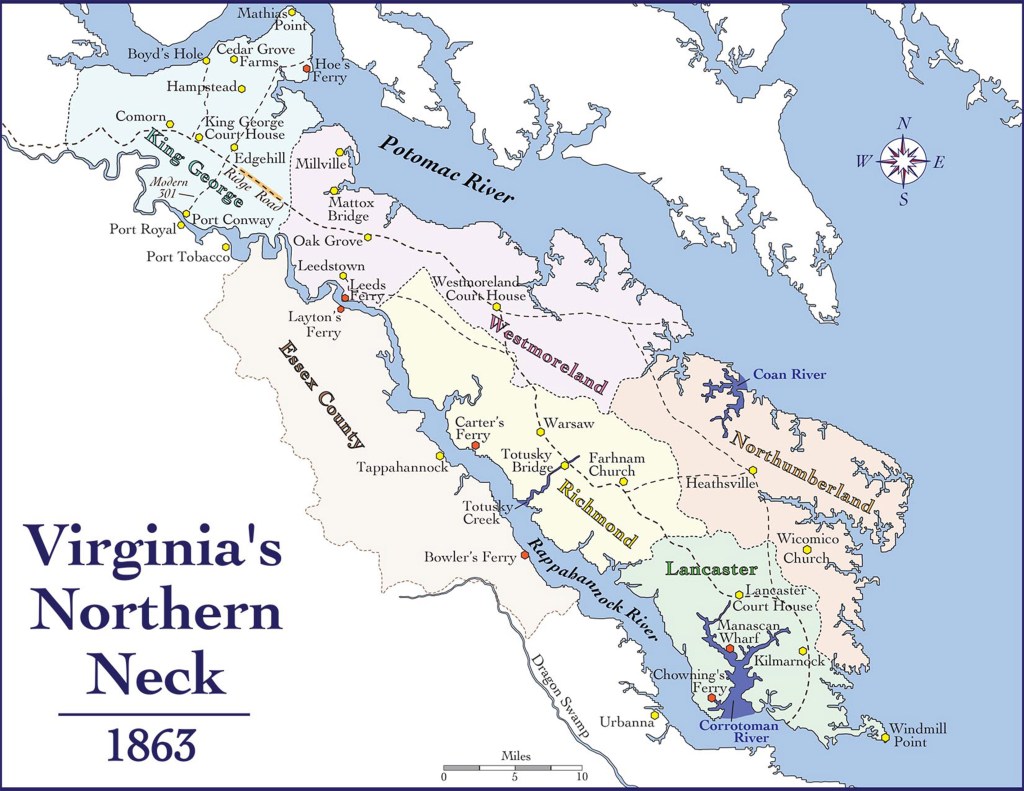
Note – This post is Part 3 in a series of articles highlighting unpublished documents related to Union activity on Virginia’s Northern Neck in 1863.
I closed my August post (Part 2 in this series) with the following (published) message from Col. Judson Kilpatrick to his division commander, Gen. David Gregg. I include the same message here for the purpose of continuity. At the time, Kilpatrick, 2nd New York, commanded a brigade by reason of seniority. I believe Kilpatrick sent the message on February 20, 1863.
“Yesterday morning, Capt. [John] Mitchell of the [2nd NY] stationed near Port Conway discovered that the Rebels were placing into a large flatboat (with a log cabin on it capable of holding 100 men) sacks and muskets, and that a large number were at work about there – some 60 in all. Fearing that an attempt might be made to cross, I strengthened my line of pickets at that point. I am satisfied now that the enemy are but on a foraging expedition down the river. Should this be true, a trusty scout will keep me advised of their movements and if they land near my outer pickets, they shall not return. At this hour all is quiet.
“There is, in a house near the dock at Port Conway, large quantities of wheat and corn. It may be possible that an attempt may be made to carry it off, but the attempt shall fail if made.”
The following message contains neither a date nor the name of the author, but I believe it to have been written by Gen. George Stoneman, commanding the Cavalry Corps, to either Gen. Joseph Hooker, commanding the army, or to his chief of staff Gen. Daniel Butterfield in late-February or early-March, possibly March 2. If someone knows otherwise, I am happy to be corrected, but based upon comments in both messages, I believe Kilpatrick’s information may have led to the unseen message from Butterfield and this response from Stoneman. The Confederate incursion at Hartwood Church on February 25 would have held the attention of all three men and explain the passage of time between the two messages.
“I … acknowledge the receipt of your [Communication] of yesterday’s date in regard to supplies of forage on ‘the neck’ and the propriety of sending down a portion of Cavalry to prevent its use by the enemy, and also in regard to breaking up the contraband trade in that region and intercepting mail matter now being sent between the north and south.
“My plan would be to send a small Infantry force, say a brigade, to the vicinity of Sandy Point or Heathsville to act as a support, to guard a small depot to be located there, to receive such prisoners and property as might be captured or secured, and if necessary or expedient to act on the offensive in the direction of Tappahannock and Urbanna confining its operations of course to the north side of the Rappahannock river.
“This force of Infantry would relieve all the Cavalry sent in that direction from guarding any fixed points and enable every man to be kept in motion free from all encumbrances.
“I would keep at least five or six squadrons down on the lower end of the neck, but would send them down by water, sending a squadron each day to relieve one already there; the one relieved to return by land scouring thoroughly the country passed over on its return to camp. The Cavalry force to be sent by water, with the view of saving the horses and to hide their operations from the enemy.
“This arrangement would relieve nearly a regiment now doing duty in the vicinity of Port Royal and Port Tobacco.
“To make the operation of this force effective, instructions should be given to take possession of all means of transportation found in the hands of every man unwilling to take the oath of allegiance, particularly horses and no male inhabitant should be permitted to roam about the country without a pass from the constituted Military authorities. An exact account should be taken of all the produce on the neck and the owner held strictly responsible for a proper disposal of the same, and any person found furnishing supplies of any kind to the enemy on the other side should be treated as an enemy. [All emphasis in original].”
Several other unpublished messages, all dated March 2, also lead me to conclude the message above was written on March 2 or shortly before. None include a time, so placing them in the proper order is also a matter of guesswork, though I believe the first two would have been sent at about the same time. The first is from General Butterfield to Gen. James Wadsworth, commanding the 1st Division in the 1st Army Corps.
“[General Hooker] directs that you send a force down the Neck for the purpose of stopping any mails or supplies in transit across the Neck between the Potomac and Rappahannock seizing any soldiers or officers of the enemy, resident or visiting on the Neck. Taking any mules or animals needed for the Quartermaster Department or any supplies that are likely to be made use of for the enemy or to aid him in any manner. Seizures should only be made from the wealthy of secession proclivities. Persons known to have aided the enemy in any way should be brought in.
“Receipts, a few found enclosed marked ‘A’, must be given for any article taken. Marauding or pillaging must not be permitted under any pretext whatever.
“Col. Ingalls, Chief Q. M., will furnish the necessary transportation. The officers in charge must be held responsible that they are provided with everything necessary to accomplish the objects of the expedition. Guides may be (possibly) selected from the contrabands brought in from the last expedition down the Neck.
“A [ferry] boat will be ordered to Belle Plain for the purpose of taking down a party of Dragoons. The Dragoons will be ordered to report to you tomorrow am. These Dragoons will be landed at Heathsville and act under your instructions, returning by land to our lines along the river (Rappahannock) road, examining the country and furthering the purposes of the expedition. They will be provided with two days’ forage and rations and expected to subsist themselves until their return.
“The infantry forces you can send to such points as you desire and all transportation desired will be furnished.
“It is expected that you will complete a thorough examination and search of the entire Neck this side of Heathsville. It is desired that the mounted party should get as full information as possible with regard to the landings on the Rappahannock and seize and destroy any vessels, boats or rafts within their reach in the Rappahannock.
“You can dispatch two or more infantry parties as you think proper.
“Document B enclosed is a schedule showing the mail routes, dates, etc. It is to be returned after the expedition is completed. Document C are the reports of recent expeditions furnished for your information, to be returned. Document D [is a] statement from Provost Marshal at Washington that will probably prove [of] some assistance and information. Let the Comd’g Officers be furnished with copies. The details not herein specified or omitted are left to your discretion, that they may be properly arranged.
“The cavalry party reports to you to save any collision and that all may cooperate to the same end. The Ferry Boat sent down with the Cavalry can be loaded with mules or horses for the return trip. If it is not possible for the infantry force to secure them, the cavalry might send them into Heathsville, from its vicinity under charge of a small party…”
I did not see any of the listed enclosures with this document.
The following message is from Butterfield to Stoneman.
“[General Hooker] directs that you send a force of cavalry to consist of 80 men with officers to report to Gen. Wadsworth by 1000 tomorrow. They will be provided with two days forage & rations. They will be sent by water (Ferry boat) to Heathsville and return from there by land. The enclosed extracts from a letter of instructions to Gen. Wadsworth are furnished for the information of the commanding officer who will further consult with Gen Wadsworth with regard thereto. Your pickets will be notified of the expected return of this party. You will direct the commanding officer that in case the transportation provided should not have sufficient capacity to carry safely all his command he will reduce the number (not below 65). The sail by water will be about 8 hours. The extra supply of forage, if any, beyond the amount required for the 8 hours sail may be at the discretion of the officer left onboard the ferry boat for the animals expected to be returned by the boat.”
The last of the three messages dated March 2 is from Col. John Taylor, commanding the 2nd Brigade in General Gregg’s division.
“…I send you 1st Lt. Robinson of the 9th VA captured yesterday morning in Leedstown. On visiting our line on Saturday, I ordered the officer in command at Port Conway to send a squad of 20 men…on the River Road to be able to reach Leedstown by daylight. The order was carried out and the result was the capture of the Lt. and one barrel of whiskey, which was being smuggled across from the Potomac.”
In his history of the 9th Virginia Cavalry, Robert K. Krick describes Charles Robinson as being “corpulent,” which may have hindered his ability to avoid capture, but also as a man “full to the brim with good nature…he lavishes it in abundance on all around him…good humor, kindness and generosity.” Robinson was paroled on April 6, 1863, and then wounded and captured again at Upperville, June 21, 1863.
Two days later, Taylor, still commanding the picket line in King George County, sent the following to General Gregg.
“…I sent a squadron from these headquarters [near King George Court House] to scour the country on our left and to proceed down the Neck some 15 miles; at the same time a squad of 20 men started from these headquarters near Port Conway.
“They started from here about 8 o’clock last evening and returned this morning [March 6] without any success or discovery.
“We are informed by contrabands that a home guard is kept up some distance below us and that a number of arms are concealed in that vicinity. Should it meet your approval, we will give the country an effectual scouring for [some] distance.”
Based upon a message to Gregg dated March 8, Colonel Taylor sent another small expedition into Westmoreland County on March 6.
“… The company I sent down the neck on the morning of the 6th returned last evening and report the following.
“They reached Leedstown at daylight discovering nothing of interest, then proceeded to Carter’s Wharf 8 miles below (Leedstown) where they found 2000 lbs bacon & a lot of tea and tobacco. The bacon was destroyed, together with two large flat boats and one fishing boat. The officer in command learned the bacon destroyed was but half of the lot, the other having been sent over the Rappahannock the night before. The boats above mentioned having been used for that purpose.
“He then proceeded to Wilson’s Farm on the Potomac, where he learned from citizens, that an extensive smuggling trade is carried on, also the names of the parties engaged. Several squads of [the enemy] were seen at different places consisting of from 3 to 7 men each, several shots were exchanged with one of these, but without effect. The nature of the country was such they could not be captured.
“Nothing was seen or heard of the expedition from below…”
I have not identified either the regiment involved in the affair or the officer in command. Note that Taylor refers to the larger expedition mentioned above in the orders to generals Wadsworth and Stoneman. The two raids overlapped and the men from both returned about the same time. I will discuss the larger effort next month.
Sources:
Unpublished documents from the National Archives
Robert K. Krick, 9th Virginia Cavalry


Thanks Ron.
Keith 216 536 5835
LikeLike