In the years since I began this blog, I have posted several articles related to events on Virginia’s Northern Neck. I have linked most of them several times since and will not do so again, but if you are interested you may employ the search box on the site.
I have been asked from time to time about other events on the Northern Neck and have finally determined to post a series of, what I believe are all, unpublished reports and communications related to Union cavalry expeditions in the region.
I asked Julie Krick to prepare a map of the area to accompany the posts, and we made a valiant though not exhaustive effort to identify and locate as many of the locations as possible for the map. We examined a series of war-date maps, as well as maps of more recent vintage with varying success. Because I wanted to present the entire region on one map, I made the decision to keep road names to a minimum. The scale of the map meant that it would be easily cluttered with too many names. In addition, road names have changed and, in some cases, roads have been realigned in more recent years. Those decisions aside, I hope the map, which I will include with each post, proves helpful and I’m grateful for Julie’s help.
All of these accounts are from late-1862 through the spring of 1863, when the armies faced each other across the Rappahannock River for months. During their winter encampment, Union soldiers devastated much of Stafford County as they cut wood for cabins, roads, heat and other needs. Southerners would have done the same along their side of the river. The lack of forage around Fredericksburg and the region to the south forced Generals Lee and Stuart to rotate their cavalry brigades out of the region during the winter in order to rest and provide for their horses.
Union cavalry did not enjoy the option of being rotated off the line in the same manner. Instead, the cavalry maintained a long picket line that extended (as discussed and mapped in previous posts) to near the King George and Westmoreland County line. Their presence took a toll on the farms in King George County, but by comparison to farms in Stafford County, King George and the counties to the south or east remained relatively untouched by the hard hand of war. Plentiful and badly needed crops drove Southern troops to cross the Rappahannock River on a near regular basis, employing the numerous ferries and other small boats to transport the foodstuffs back across the river. Many of the raids and expeditions down the Neck were the result of Union efforts to interdict these Southern forays. What follows over the next several months are not meant to be in-depth studies of these raids. I simply want to expand the record of these events with what I believe to be unpublished reports and communications related to them.
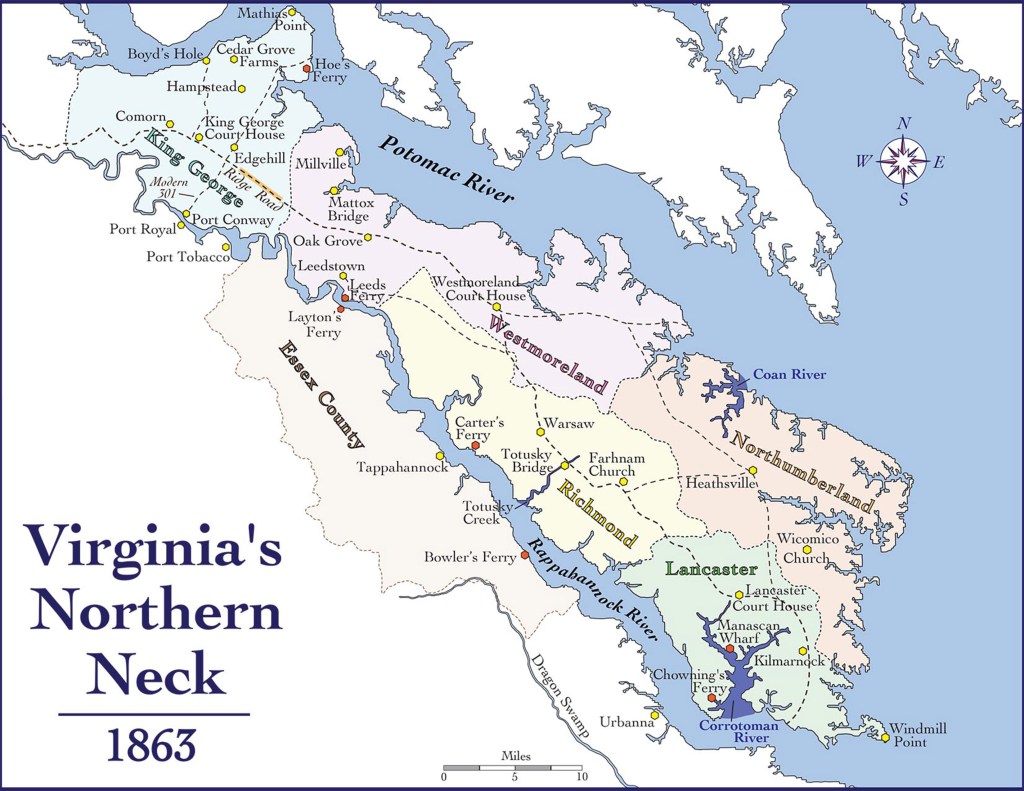
Arguably, the first such effort came in late-December 1862, when Gen. David Gregg, commanding the cavalry division attached to the Left Grand Division, sent Maj. Otto Harhaus and his 2nd NY Cavalry into Westmoreland County. The major’s report to Gregg of December 23, is in the OR, but the communication below, from December 22 is not.
“…I arrived at [Oak Grove] last night, where I encamped my command… We met nothing of importance.
“At [0500] today, I sent a patrol of a Sgt. and 6 men to Leedstown, who report that there is no enemy on this side of the Rappahannock River, but that 4 gunboats stopped at Leedsburg yesterday, two of which have gone down the river. [Leeds or Leedstown and Leeds Ferry were two different locations, which may have confused Harhaus, resulting in the Leedsburg reference].
“From all information which I can obtain from citizens and Negroes, it is evident that there are no Rebels on this side of the river. It has been reported to me that 3 or 4 Regts of Rebel cavalry are encamped near Port Royal and that none were farther down. I feel, however, certain that there is a camp in the vicinity of Leedstown, as I observed dimly the lights of their camp fires.
“Smuggling has been almost stopped, as there is too much risk connected with it and large quantities of goods have been seized by the Rebel government, which tried to stop this unlawful traffic.
“There are no boats on the other side of the Rappahannock and a citizen from [Warsaw] CH informs me that the horses captured from the 8th PA had to be swum across the river, by which operation some 12-14 were drowned.
“I am moving my command in the direction of Tappahannock and shall push one squadron as close to this place as possible and return to [Oak Grove] today if possible.”
General Gregg forwarded the major’s report of December 23 to Gen. William Franklin on December 24, advising:
“I…report the return of the 2nd NY Cav, sent by me on the 22nd to examine the country lying between the Rappahannock & Potomac Rivers. The command proceeded as far as Tappahannock, examining all the roads and thoroughly scouring the country. None of the enemy were found, nor could it be ascertained that they had recently been north of the Rappahannock. Smuggling is about entirely suppressed. Communication was had with the gun boat flotilla, and information was received that there was no indication of the enemy being about Leeds or below.”
Trying to confirm some of what Major Harhaus refers to in his report is difficult, but the 8th Pennsylvania earned a rather poor reputation during their stint on picket duty in late-December. In an account dated December 24, a newspaper correspondent briefly mentions a Southern raid across the river, in which the men employed rafts to effect the crossing. The reporter mentions that the Pennsylvanians, aided with early warning provided by slaves escaping to freedom, thwarted the effort. If the information is correct, the raid occurred just after the New Yorkers retired upriver and is not the raid mentioned by Harhaus. The correspondent also mentions that the Union gunboats, that patrolled the river, had recently retired downstream to avoid being trapped by ice. You may find more on the Pennsylvanians and their stint on duty over the holidays here.
On January 2, 1863, the provost marshal at Army of Potomac headquarters, sent the following to his superiors.
“Statement of Pvt. Edward Seaman, 8th VA Cav
Was at Port Royal, VA during the fight at Fredericksburg. Crossed the river where three of the scow boats used in crossing, placed ends together would make a perfect bridge: the river was wider above and below. Picketed the night before the ‘Raid’ on the northern side of the river: about 400 crossed the next night (which was probably Monday December 22, 1862) not far from Smith’s Wharf. Mrs. Taylor’s House was a little below. The balance, it was said, were to cross for the purpose of getting in our [the Union rear] rear, they were said to be about 2000 in number. There are only about 27 of Capt. Smith’s original company from Baton Rouge left. These are attached to Fitzhugh Lee’s Brigade.
All of the officers with us I heard said belonged to Gen’l Jackson’s staff. A colonel had command, but do not know his name. Had made a movement before, to cross, to get into Maryland…but that night the gunboats (5 in number) came up to Port Royal…”
Listed on the cover sheet as a deserter, the Southerner appears to have used an alias and miss-identified his regiment. He also speaks of a Southern raid across the river that I am unaware of. The date in parenthesis is given by the provost marshal but does not correspond correctly with the events mentioned by Major Harhaus. Though the information provided in this ‘intelligence report’ appears to be widely inaccurate, it may have, again, placed the Northern Neck in Yankee cross-hairs.
On January 13, Col. Horatio Sickel, in temporary command of the 3rd Division, 1st Corps, led an expedition of unknown size to Westmoreland County, assisted by Maj. James Brady, Chief of Artillery for the division.
In his report filed the following day, Sickel wrote:
“I…send you a report of an expedition, which left my picket line yesterday morning and returned in the evening, bringing with them four or five horses, the property of a Rebel officer, by the name of Edward [Broun – his name is not clear].
“…Yesterday, about 0700, five colored men were brought to these HQ who had presented themselves to the Grand Guard for admittance. [Remember that Northern troops would have been spreading word of the Emancipation Proclamation.]
“They informed me that [Broun] was at his house the evening previous, in company with some 20 Rebel soldiers and that some of them had dressed themselves in the garbs of farmers and had come to our pickets and conversed with them on subjects relative to our camps etc. I immediately dispatched Maj. Brady and Capt. Baird to our lines to caution the men against holding conversation with anyone and to arrest and send in all suspicious persons…
“After discharging this duty, Maj. Brady and Capt. Baird, with a small detachment of cavalry, visited [Broun’s] house. As they neared the premises, the rebel company, [Broun] at their head, mounted horses, and left in great haste. Our party gave them chase…the enemy escaped…”
Major Brady also submitted a brief report.
“I…visited in company with Capt. [Edward Carey] Baird, [Asst. Adjt. Gen.], 3rd Div, 1st Corps…the premises of Edward [Broun], an officer in the rebel service reported to be — with his family in Westmoreland County, VA and found that a premature alarm created by the cavalry prevented his capture. Apparently reliable information came in whilst there, that this officer with others have [for some] of their objects the direction of the removal from the lower counties the entire serviceable slave population to the south side of the Rappahannock, the collection of horses for the Rebel service, and the transmission of contraband merchandise across the Peninsula between Mattox Creek and Leeds Ferry.
“[Broun’s] horse was found on the premises, along with 3 other saddle horses. They were removed and turned into Div QM Department for the use of the U. S. Government.
“I also report several redoubts and rifle pits visible on the high grounds south side of the Rappahannock, extending below Lamb’s Creek Church.” Newspaper reports from the same time period confirm that local farmers were trying to send their slaves farther south to prevent their capture or escape.
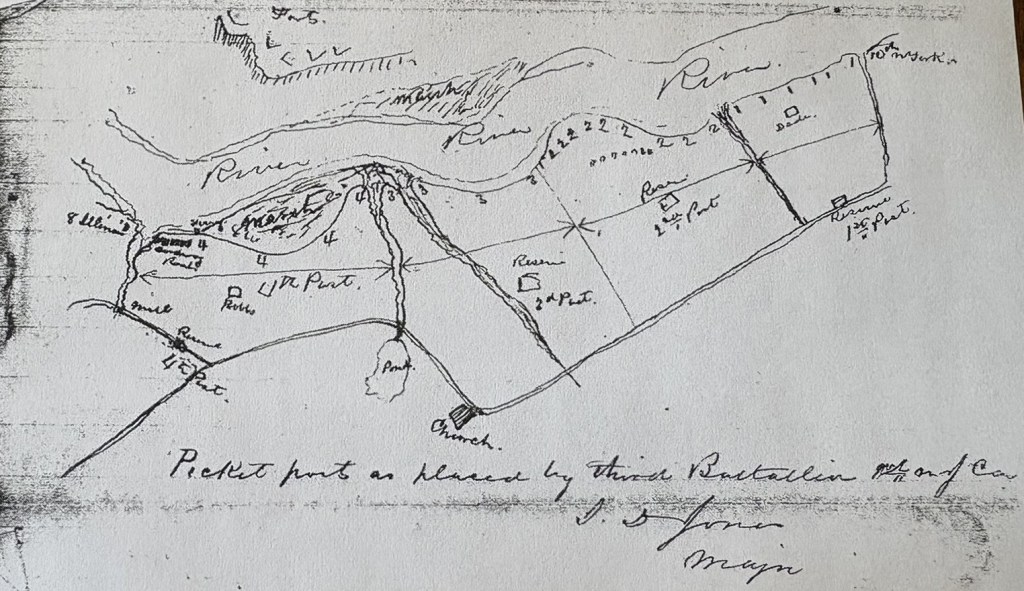
The above Union picket map shows the Confederate fortifications across the Rappahannock River from Lamb’s Creek Church.
On January 28, General Gregg sent the 10th NY Cavalry to scour several points along the Potomac River in King George County for Union deserters. Boyd’s Hole was an especially popular departure point where Union deserters gathered before being taken across the river to Maryland. Gregg told Maj. Matthew Avery to “… proceed with your regiment to the point of intersection of the road leading to King George CH with that leading from the latter place to Hampstead. From this point you will send one squadron to Mathias Point, one squadron to Boyd’s Hole, one squadron to Hoes Ferry… to arrest any deserters from this army…and to destroy all small boats found along the river… You will take every precaution to prevent any marauding on the part of your command. Should any of the officers…permit their men to appropriate or despoil private property you will at once arrest them…” The historian for the regiment remembered making the journey “in a terrible storm, over roads well-nigh impassable.
Now, in addition to trying to prevent enemy troops from moving food stuffs across the Rappahannock River, Union troops were also being used to halt the flood of Yankee deserters across the Potomac River.
The following day, Dr. Richard H. Stuart sent the following letter of complaint to General Hooker. Stuart owned two farms near the Potomac River in King George County. Both properties, including one named ‘Cedar Grove,’ were in the area of Boyd’s Hole and Mathias Point. His neighbor, Abram Hooe, owned a farm and also operated a ferry nearby. His home had been destroyed by Union troops earlier in the war.
“I …appeal to you to interest yourself to have some general order issued from Gen. Head Quarters, to restrain the soldiers of the army and particularly the cavalry stationed around us, from taking private property without authority.
“At present they go about in parties of from 2 to 20 by night and day and … taking what they choose. If we are not to be deprived of everything, let us know it and give us some protection for what we are permitted to call our own. I have had taken from me to this date 11 horses and 19 head of cattle, about 1,000 bushels of corn besides oats and fodder. The 8th Illinois Cavalry has been for some time picketing around us, but parties from other regiments are constantly scouting about and taking what they can. Yesterday four men from the 3rd Indiana Cav went to my farm on the Potomac, spent the night and in the morning drove off to their camp 6 head of cattle. I saw them when they came yesterday but they said not a word about wanting cattle. This morning a large party of the 10th NY Cav went to the same place and … broke into my house, now unoccupied and took off some of my property. They then went on the farm and broke into some of the Negros’s houses and robbed them. Indeed, they are constantly taking [food] and pigs from the Negros without paying for them.
“I still have a large number of dependents ‘Americans of African descent,’ chiefly old men, women, and children to provide for and if my work horses and cattle are all taken it will be impossible to provide them the necessaries of life… I appeal to you in the name of our common humanity to get something done to put a stop to this wholesale plunder…
General Gregg responded to Hooker, explaining:
“The within communication from Dr. Stuart having been referred to me …is returned with the following statement. The 3rd Regt. of Indiana Cavalry complained of having taken 6 head of cattle is not in my command but belongs to…Pleasonton’s Division.
“The 1st Maine Cavalry has at no time been in King George County, since on one occasion, when one commissioned officer and 20 men accompanied [two] staff officers of an infantry command to that section in pursuit of deserters. Those staff officers seized four horses, the property of citizens, brought those horses back with them, and still have them in their possession. A statement of this case, together with the names of these officers was forwarded by me to the Provost Marshal of the Left Grand Division.
“The 10th NY Cavalry was sent … to King George County in pursuit of deserters. Before the departure of the regiment, I directed an order to its commander forbidding any private property of any description being taken at all and requiring that any officer who should permit his men to pillage or maraud should be sent to me in arrest. Forage for ten days was carried from here in forage sacks. On the return of the regiment, the commander reported that my orders had been implicitly obeyed. Nor can I, after a thorough examination, find that he reported incorrectly.
“The parties of cavalry complained of as constantly harassing citizens certainly do not belong to this command, the duties of the regiments not calling them in that direction. No case of pillage has passed unnoticed by me, nor has any offender gone unpunished.”
General Pleasonton sent Dr. Stuart’s complaint to Col. William Gamble, then commanding the 1st Brigade, that included the 3rd Indiana and 8th Illinois. In his response, Gamble explained:
“…So far as my command is concerned, the necessary forage and beef has been taken in a proper manner from the abundance of the wealthy disloyal citizens in this vicinity where my men are on duty. There has been a part of the 1st Maine Cav and the 10th NY Cav passing at different times through this locality on special duty by order of Gen. Gregg, also some infantry passed along the bank of the Potomac to Mathias Point, in pursuit of deserters. What these troops may have done to the inhabitants, on their march, I am unable to say…”
In forwarding Dr. Stuart’s complaint to the appropriate subordinate officers, General Hooker had noted:
“…The commanding general is determined that the records of this army shall not be stained by the acts of pillagers… If property is required for public use it will be taken by the proper agents and the proper vouchers will be given first, but individual indiscriminate public plunder will not be permitted under any circumstances whatever…This army must emulate the virtues of soldiers, not their vices.”
In my opinion, commanders would have ‘investigated’ claims of theft or marauding based upon their own differing views toward the war. The statements above suggest a vast gray area between what commanders actively tried to prevent and what they ignored. A newspaper correspondent gave another view in an account from the same time period.
When a farmer complained, in December, that 100 cattle, recently purchased for the Confederate army had been seized by Northern troops, he demanded a receipt. The paper he received from the officer in command included the following, “I believe [the farmer] to be a disloyal man and a traitor to the Government of the United States.’” The size of the herd seized, if accurate, suggests, to me at least, that the animals had already been sold to the Confederate government. Union troops could not hide a herd of that size and commanders would have had trouble explaining how they could not find such a herd. Having been sold to the Confederacy, these animals would have been treated differently than the theft of one or two animals stolen from a citizen by foraging soldiers. But the comment describing the owner as a traitor corresponds with the attitude expressed by Colonel Gamble.
To be Continued
Sources:
Unpublished Documents from the National Archives
The Official Records
The Philadelphia Press
Noble Preston, The History of the Tenth Regiment of Cavalry

