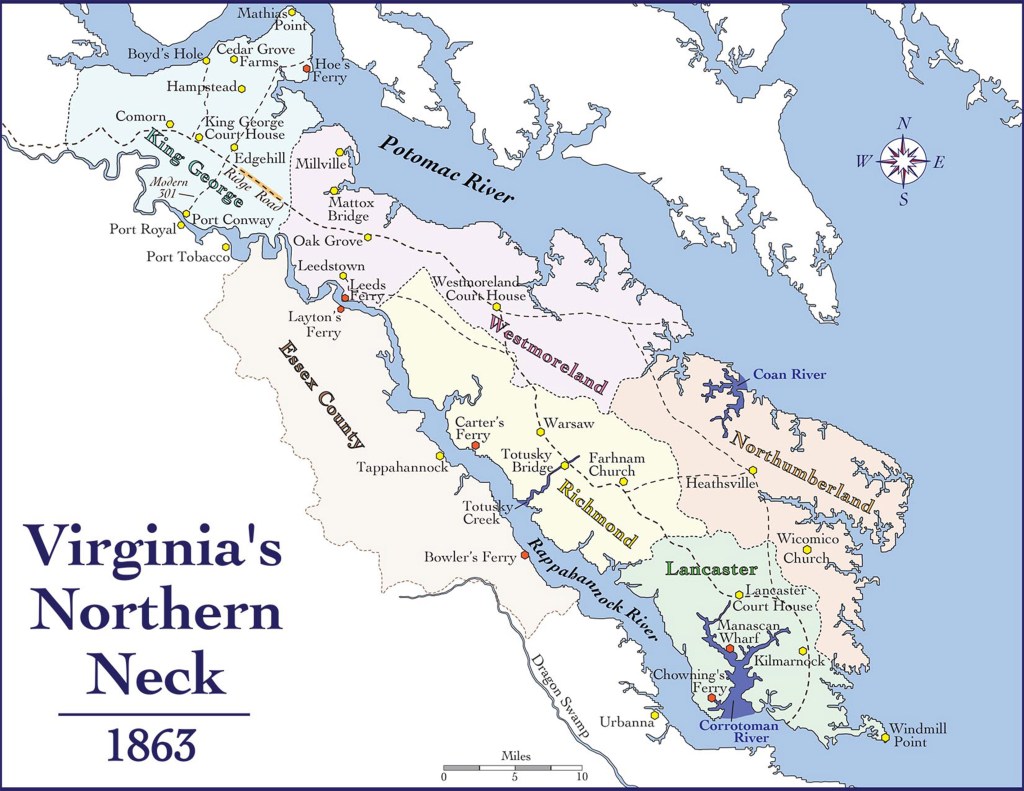
Note – This is Part 4 in a series of articles highlighting unpublished documents related to Union activity on Virginia’s Northern Neck in 1863. This month’s post will cover the expedition ordered by General Hooker on March 2. I included his instructions in full last month, but as a brief reminder, I begin this month with Hooker’s opening paragraph to Gen. James Wadsworth, commanding the 1st Division in the 1st Corps.
You will “send a force down the Neck for the purpose of stopping any mails or supplies in transit across the Neck between the Potomac and Rappahannock seizing any soldiers or officers of the enemy, resident or visiting on the Neck. Taking any mules or animals needed for the Quartermaster Department or any supplies that are likely to be made use of for the enemy or to aid him in any manner. Seizures should only be made from the wealthy of secession proclivities. Persons known to have aided the enemy in any way should be brought in.”
On March 8, Gen. John Reynolds, commanding the 1st Corps, advised Hooker of Wadsworth’s return.
“In answer to your communication in reference to the contraband trade through Lancaster Court House, I have to state that this expedition under Capt. [Craig] Wadsworth has just returned, having been three or four miles below Lancaster CH. They could learn nothing from Contrabands as to this trade being carried on as low down as this point, the place on the Rappahannock River for this purpose being a point about 25 miles below Leeds, called Union Wharf, which was thoroughly destroyed and broken up by our party. The only batteries they could hear of are on the opposite side, in that neighborhood “[Springs] Point,” they having been temporarily brought there while the gunboats were on the river. They understood these batteries to have been removed several days ago.
“It is therefore my opinion that it would be useless to send an expedition to this point. The gunboats, it appears to me, ought to be able to ascertain and [prevent] this trade at this point, if there is any of consequence.
“Capt. Wadsworth’s report will be forwarded in the morning. They brought in some 47 mules and 42 horses, mostly from Richmond, Lancaster, and Northumberland counties. Some 25 or 30 Contrabands, about half of whom were employed at “Union Wharf’ in ferrying across the river.”
Col. George Sharpe, commanding Hooker’s Bureau of Military Intelligence, also sent a note to the army commander, stating:
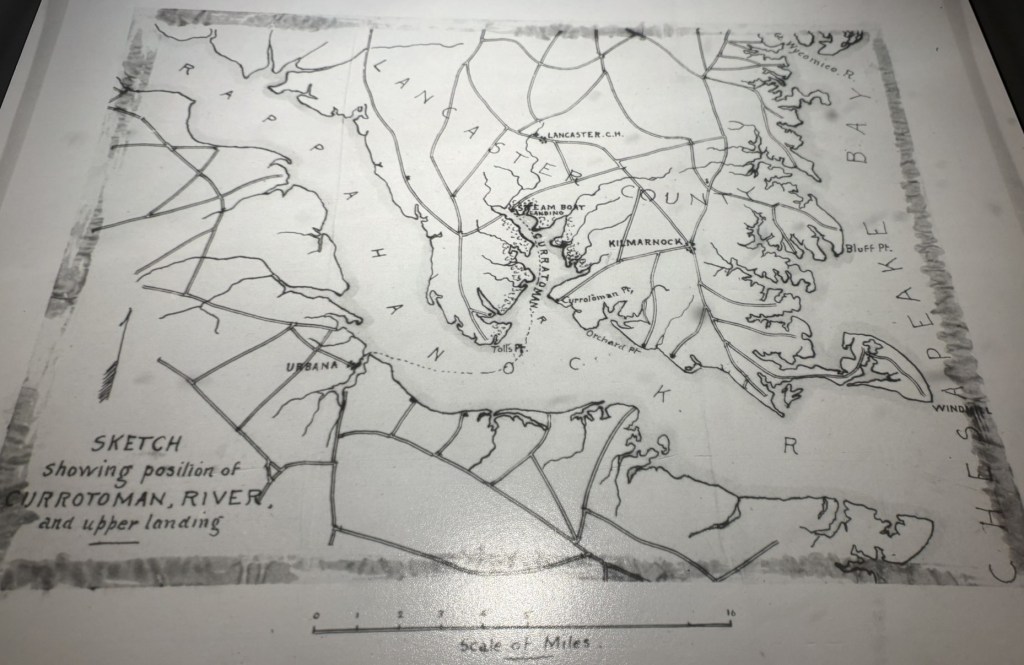
“[Mery] Point cannot be located with any certainty, by any map or chart at these Headquarters. At the head of navigation on Corrotoman River, is a steamboat landing, some six miles from its mouth. The water to this point is good, being some 17 feet deep at mean low water. This may be the point referred to in the accompanying report.
“Capt. [William] H. Paine, [Topographical Engineers], repeats information recently obtained from contrabands, that boats have been landing of late, in the creeks between Windmill [Point] and Great Wycomico River, on Chesapeake Bay. That these boats discharge cargoes, which are transported by wagons to some point on the Rappahannock River, unknown to informant, by road leading through Lancaster Court House.
“The batteries mentioned in accompanying report must refer to those on the opposite shore of the Rappahannock, and opposite to the mouth of the Corrotoman River. Urbanna is the principal landing on the opposite shore, although there are several nearly opposite the mouth of the river.”
With his message, Sharpe included the following map (photographed from a microfilm screen), almost certainly drawn by Captain Paine.
General Wadsworth assigned command of the expedition to Col. Walter Phelps, commanding the 1st Brigade in Wadsworth’s 1st Division. Phelps submitted the following report.
“…I embarked with a detachment of 250 infantry on board steamer James A. [Sterns] at Pratt’s Landing Tuesday March 3, 1863, at 5:30 pm. A detachment of 80 cavalry followed on the ferry boat [Talacea]. We anchored off Piney Point from 3 to 6 am Wednesday, reaching a point off Coan River at 9 am, having no pilot on board familiar with the channel, we ran aground and were delayed two hours. I caused the channel to be sounded out and steamer lightened and succeeded in reaching the landing at 11 am. I immediately disembarked and proceeded to Heathsville with the cavalry, ordering LTC [Morgan H. Chrysler, 30th NY] to move forward promptly with the infantry. Seventy-five minutes after disembarking, the cavalry was drawn up in line in the [town] (distant nearly four miles from the landing. [Part cut off] dispatched 80 men to the south of Heathsville at 1:30 pm, with a view of carrying out in part my instructions. The cavalry soon followed on the road to Lancaster Court House.
“Thursday, the 5th, I sent out detachments of infantry in all directions, their labors resulting very satisfactorily. At 5 pm, the cavalry returned and formed near the infantry, the following were the results of the labors of the cavalry and the several infantry detachments. About 1,000 bushel ears of corn, 51 mules, 27 horses. Two mails seized (one 8 miles below Heathsville, south east, and one 6 miles above). Eight prisoners as follows, Richard A. Claybrook, formerly [Lt. Col.] 40th VA Regiment [served only a short stint with the regiment in 1861], charged with being engaged in the conscription, running blockade, etc. A. [Milbourne], William Brent and James Harding, Contraband traders. John W. Scott, Pierre C. Dugan and Simon I. Kemp mail carriers, en route from Richmond to Baltimore and Pvt. John W. Lackey, 40th VA at home on furlough [he had been sick for several months, treated in a Richmond hospital and probably home recovering when captured]…
“Transportation from Coan River was given a number of contrabands. I could discover no large supplies of provisions or grain, but little bacon was discovered and that in such small lots, as to render it impracticable to be moved to the transports. I could hear of no force of the enemy this side of the Rappahannock. Quite a number of enlisted men are home on furlough, which appears to constitute the only troops. I ascertained that soon after the last expedition a body of 100 cavalry was crossed over but soon returned. No prisoners were found in the jail at Heathsville and no mails in the Post Office. I am satisfied that every effort has of late been made to run off all surplus supplies and to conceal and drive off all surplus horses and mules.
“The information of the expedition being on its way was known at Heathsville and the surrounding country before a landing was affected. Most of the horses and mules were found secreted in the woods. Quite a large supply of corn and wheat might be obtained in that section, but it would require considerable time to collect it, as the transportation to be pressed into service is very limited and the points distant from the landing [emphasis in original].
“I embarked Thursday night at 9 pm, ran out to the mouth of Coan River and anchored until the morning of Friday the 6th, intending to see [Little] Run, with a view of breaking up a nest of contraband traders, whom I learned were located on its banks. The high winds prevailing and the loaded condition of the transports prevented me from carrying this into execution. On account of heavy weather, we ran into St. Mary’s Bay until 10 pm, when we weighed anchor and reached Belle Plain Saturday the 7th at noon.
“Great credit is due both officers and men for their conduct on this expedition, there was no pillaging or straggling. To Capt. Wadsworth of Gen. Reynolds staff and Lt. Daly of the 2nd Wisconsin much of the success of the expedition is due…”
Capt. Craig Wadsworth’s Report reads as follows:
“…I accompanied the cavalry force (80 men 1st Maine under Capt. Virgin) that landed near Heathsville on the morning of the 4th. Spent that day and the following on scouting through the lower counties and collecting stock. On the evening of the 5th returned to Heathsville, turned over to Col. Phelps who was in command of the Infantry force what animals and prisoners I had taken.
“On the 6th proceeded to Union Wharf via Farnum Church, destroyed two scows and five smaller boats, burnt between five and six hundred bushels of wheat, took a large quantity of chloroform and other medicines, one box of shoes and several of blankets and linen. All the above articles were turned over to the Medical Director of 1st Division. Union Wharf is opposite Young’s Point and 25 miles below Leeds.
“There were 10 or 15 colored boatmen shut up in a house at the Wharf. They had brought a scow over the evening before for a load of bacon, which for some reason had not been brought down. Most of them returned with me. They know but little as to the force or what was going on, on the opposite side of the river; they were kept at the ferry. One of them told me that there had been an infantry force encamped a few miles back from Young’s Point, but they had received marching orders a few days before and he thought they had gone. He did not know in which direction. Fitzhugh Lee’s cavalry is still on duty in Essex Co. The battery which was at Young’s Point a few weeks ago when our gunboats went up, I understand has been removed.
“On the 7th came up to Leeds and from there to Millville and on the 8th to camp. I found nothing at Leeds. The boats were on the other side of the river. I could hear of no grain or goods being shipped below Union Wharf. The farmers in the lower counties still have their grain on hand. Very few goods have been taken across the Neck in the last few weeks: our cavalry raid seems to have checked the trade. I could not learn of the enemy having been on this side in any force, since they captured some of our cavalry near Leeds, which was some months ago. There had been a squad of five or six cavalrymen across a few days before I was done collecting conscripts.
“I arrested and sent up by Col. Phelps, W. Bent [listed as Brent by Phelps] of Lancaster Court House, a speculator in contraband goods. A. Milbourne of Maryland who had been largely engaged in the contraband trade for the last six or seven months and James Harding of Wicomico Church. The latter was spoken of in a communication received by Gen. Wadsworth before the expedition embarked. One of Milbourne’s boats loaded with goods was recently taken by our gunboats on the Potomac.
“I arrested and brought with me Dr. [E. D.] Booker, who resided near Farnum Church, [Pvt. James R. Montgomery, 11th Miss], H. F. Chandler, 9th VA Cavalry [possibly Henry H. Chandler, whose service in the 9th VA had expired in early 1862. He had declined to re-enlist but later joined John Mosby’s command], and Chandler Ward. Booker was formerly [captain and asst. quartermaster] of the 47 VA but resigned some months ago [September 13, 1862], and has since been buying up produce and shipping it across the river: papers and letters in his case were forwarded with him to Gen. [Marsena] Patrick.
“Montgomery and Chandler were attached to the Signal Corps, and were on duty on the Potomac. Ward has been conscripted, sent his horse across the river and expected to go himself in a few days.
I turned over to Col. Phelps 23 mules and 18 horses, and to the QM of the 1st Division 4 mules, the same number of horses, two wagons and three sets of harness.”
Edward Tobie, in his History of the 1st Maine Cavalry, does not add much additional detail, though he states that Capt. Isaac Virgin, Co. G, took 70 men and that his detachment returned to camp by land rather than re-boarding the ships. In Tobie’s account, the enslaved, who “could not be accommodated on the transports were ordered to return to their masters; but several refused to do this and followed the cavalry on foot to freedom.”
To be continued.
Sources:
Unpublished documents from the National Archives
Edward Tobie, History of the 1st Maine Cavalry

