My post this month, like many in the past, grew from a small seed – a stand-alone March 12, 1863, Circular from Gen. William Averell that I intended to offer as a brief story to mark the anniversary of the fight at Kelley’s Ford four days later – into a much longer account offering what I hope are several related and, I believe, mostly unpublished documents that bear on the events leading to the Kelly’s Ford fight. Due to the length, I broke the account into two parts. Averell’s circular appears today, 163 years after he issued the document. The second part, related to the fight itself, will appear on the anniversary of the battle.
Most circulars I have seen are written by hand. Averell had this document printed on a press as a two-page pamphlet, titled, “Orders for Battle.” The timing is interesting: Was the document a follow-up to orders he issued in the wake of the disaster at Hartwood Church or had he an inkling that his division would be sent, just days later, against Southern cavalry in Culpeper County? I suspect the former.
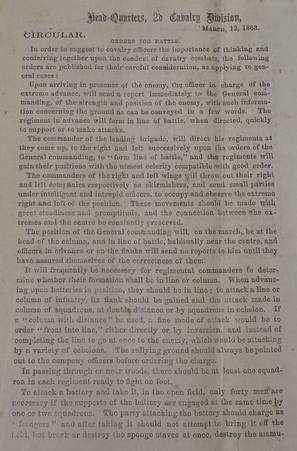
“In order to suggest to cavalry officers the importance of thinking and conferring together upon the conduct of cavalry combats, the following orders are published for their careful consideration, as applying to general cases:
“Upon arriving in presence of the enemy, the officer in charge of the extreme advance, will send a report immediately to the General commanding, of the strength and position of the enemy, with such information concerning the ground as can be conveyed in a few words. The regiment in advance will form in line of battle, when directed, quickly to support or to make attacks.
“The commander of the leading brigade, will direct his regiments as they come up, to the right and left successively upon the orders of the General commanding, to ‘form line of battle,’ and the regiments will gain their positions with the utmost celerity compatible with good order.
“The commanders of the right and left wings will throw out their right and left companies respectively as skirmishers, and send small parties under intelligent and intrepid officers, to occupy and observe the extreme right and left of the position. These movements should be made with great steadiness and promptitude, and the connection between the extremes and the centre be constantly preserved.
“The position of the General commanding will, on the march, be at the head of the column, and in line of battle, habitually near the centre, and officers in advance or on the flanks will send no reports to him until they have assured themselves of the correctness of them.
“It will frequently be necessary for regimental commanders to determine whether their formation shall be in line or column. When advancing upon batteries in position, they should be in line; to attack a line or column of infantry, its flank should be gained and the attack made in column of squadrons, at double distance or by squadrons in echelon. If a ‘column with distance’ be used, a fine mode of attack would be to order ‘front into line,’ either directly or by inversion, and instead of completing the line to go at once to the enemy, which would be attacking by a variety of echelons. The rallying ground should always be pointed out to the company officers before ordering the charge.
“In passing through or near woods, there should be at least one squadron in each regiment ready to fight on foot.
“To attack a battery and take it, in the open field, only forty men are necessary if the supports of the battery are engaged at the same time by one or two squadrons. The party attacking the battery should charge as ‘foragers’ and after taking it should not attempt to bring it off the field, but break or destroy the sponge staves at once, destroy the ammunition and cut the horses loose. The cavalry reserve should be manoeuvred during the attack to attract the attention of the enemy and confuse him.
“The second brigade in column will form in ‘close columns,’ from 400 to 1,000 yards in rear of the first line and behind the right, left and centre. Detachments for turning the enemy’s flank will generally be made from the second brigade in line of battle. The question what arm shall be used is one of the greatest moment and should be decided by commanding officers promptly; there should be no indecision.
“The carbine is intended to strike the enemy at a distance of from 50 to 500 yards and should be the weapon used most by skirmishers and by men fighting on foot. A cavalry man on foot who can use a carbine and six-shooter skillfully, taking advantage of cover, is formidable. A volley from the carbines of a line mounted, delivered at 200 yards distance, and aimed at the breasts of the horses, ought to be effective. Where it is practicable or possible to reach the enemy with a column, the sabre should be relied upon and the men instructed to make points instead of cuts. The pistol should only be used by skirmishers closely engaged by men fighting on foot or where circumstance render it the only effective weapon. It should generally be regarded as a reserve arm to be drawn when dismounted or where the enemy is near, but inaccessible by reason of intervening obstacles.
“Should a ‘horse battery’ accompany the division, a good reliable squadron with carbines will be detailed to constantly attend and support it.
“The handling of the advance guard and the disposition of flankers will be directed by the General commanding at the head of the column.”
Still concerned with the combat effectiveness of his division, Averell, just days before his fight at Kelly’s Ford, gave his men a template for battle. The timing raises questions as to when and how the plan for the Kelly’s Ford expedition developed. I will offer some thoughts in a few days.
Sources:
Unpublished documents from the National Archives
 Small But Important Riots
Your talents are amazing.
LikeLike
Great article again Bob. I like orders like these with tactical details.
The instructions to charge artillery as foragers, that is as skirmishers rather than stirrup to stirrup was also a rule for the French Napoeonic light cavalry.
So many people with an interest in Civil War cavalry think the sabre was a weapon only of the past. We knowthat is not true. Averill’s order to use it proves that. Stuart issued a similar order.
Tom Bookwallter
LikeLike
Thank you, Tom, and you are certainly correct as to the saber. Gen. Gregg issued a similar order just after Brandy Station and I believe Kilpatrick did so as well. I believe they also wanted to instill in their men a willingness to close with the enemy.
LikeLike
it seems well thought out, but no plan survives first contact with the enemy. When I can find some time, it’ll be interesting to check how well this worked out against the account in Eric’s “The Cavalry Comes of Age”.
LikeLike
Larry,
I considered the very idea of comparing his plan against the actual battle. And while doing so might still be interesting, and your thoughts appreciated, I don’t think he wrote that in preparation for the fight. I think it was more of a ‘this is how we will do things in the future.’ And as you state, no plan survives first contact, his first contact was a very tough fight to cross the river. Once finally across, surprise was gone.
LikeLike