In early-April 1863, with the spring campaign season approaching, President Lincoln, along with his wife, Mary, his son, Tad, and assorted friends, sailed down the Potomac River to the army’s massive supply depot at Aquia Creek. From there they traveled by train to Falmouth, before boarding ambulances for the final leg of the journey to Gen. Joseph Hooker’s headquarters. Lincoln had come to boost morale, mend fences in the politically riven army and to meet with his army commander. Delayed en route by a heavy snowstorm, Lincoln reached the army on April 5, Easter Sunday.
The President had played a role in the organization of the Cavalry Corps in February and Hooker now intended to put his horse soldiers front and center for Lincoln to review. Plans for the massive review began by April 3, if not before. While many accounts of the review may be found in letters, diaries, newspapers and regimental histories, none of the orders for the review appear in the Official Records. Rather than giving you a detailed account of the event, I want to present several of the orders issued by Gen. George Stoneman and his subordinate commanders.
The first is a circular issued on April 3, by General Stoneman at Corps headquarters.
“Commanding officers of divisions and independent Brigades will hold their commands in readiness to be reviewed Sunday the 5th at [noon]. All the troops who can safely be withdrawn from the picket line will be ordered to join their regiments.
“The regiments will be reviewed in marching order with pack trains, etc. complete.
“Further instructions as to place of review etc. will be sent tomorrow night.
“The President will probably be present, if not the Corps will be reviewed by the Comd’g Gen’l of the Army of the Potomac.”
Col. John McIntosh issued an order to his 2nd Brigade, in Gen. William Averell’s 2nd Division, on the same day, though the wording is confusing. As the order states, General Averell planned to review the brigade, and there is no mention of either Lincoln or Hooker. As neither McIntosh’s order nor Stoneman’s carries a time stamp, Averell may have planned a review of his own and then shifted gears once Stoneman’s circular arrived.
McIntosh’s order is worth including, however, even if superseded, due to the detail he provides as to the manner in which the man are to form, the equipment to be worn by the men and how they are to wear that equipment, as well the information regarding the positions to be taken by the regimental officers, trumpeters and the pack mules.
“This Brigade will be reviewed on Sunday morning April 5 by the General Comd’g the 2nd Cavalry Division. The regiments will be formed at [0930] on the plain below the 1st R.I. Cavalry camp in the following order: 1st – 4th Penn, 2nd – 16th Penn, 3rd – 3rd Penn.
“The regiments will form in close column of squadrons, with the trumpeters in single rank on the line of and ten paces distant from the 1st squadrons of their regiments. The troopers will appear in forage caps and jackets, haversacks will be slung from left to right and canteens from right to left, overcoats will be neatly strapped on the pommel and blankets on the cantle of the saddle.
“The squadrons will be formed of 4 platoons of 12 files if practicable but should there not be men enough in any regiment to form 4 squadrons of 48 files, then the platoons may be reduced to 10 files.
“The commanders of regiments will march 12 paces in front of the 1st squadron of their respective regiments with their regimental trumpeters at the prescribed distance in front of them. The majors opposite the centre of the 1st and 4th platoons of the leading squadrons of their regiments and 6 paces in advance of the company commanders. Squadron captains will march on the side of the guides and four paces from the flank of their squadrons.
“The regimental pack mules will be packed ready for the march, one man leading 6 mules. These men will be taken from the cooks. The trains will be formed 100 paces in rear of their respective regiments, under charge of a suitable non-commissioned officer.
“It is particularly enjoined upon regimental commanders to see that their regiments appear to the best possible advantage.”
General Stoneman issued further instructions on April 4, to include mention of both Lincoln and Hooker.
“The head of each column of this corps will be expected to reach the review ground tomorrow at [1000] at the latest. The ground lies north of the camp of the Regular Brigade, and near the intersection of the road from Belle Plain to Falmouth and that to [Bell] Air in the vicinity of Gen. Birney’s Headquarters.
“The review will be by Troop, and in the following order of march: Buford, Pleasonton, Averell, Gregg, Robertson and Rush.
“Staff officers from these HQ will meet the commands as they arrive on the ground and designate the line to be occupied.
“Capt. Robertson will be prepared to fire the salute for the President or Commanding Gen’l, as the case may be, but will not fire until he receives due notification from the commander of the corps.”
Due to Lincoln’s delayed arrival, Stoneman issued another brief circular on April 5.
“The Cavalry Corps will be reviewed tomorrow April 6 at [noon] by his Excellency, the President of the United States. The same orders as issued yesterday will be observed, excepting that heads of column need not arrive on the ground until [1030]. The staff officers from these Headquarters will meet and direct them there.
“Capt. Robertson will be prepared to fire the national salute. His ground having already been indicated to him, General Buford will form without waiting instructions through a staff officer.”
Capt. James Robertson, commanding Batteries B and L, 2nd U.S. Artillery, two batteries of horse artillery, would fire a 21-gun salute to announce Lincoln’s arrival.
The division commanders then issued their orders, as evidenced by General Gregg’s circular for his 3rd Division of April 5.
“Regimental commanders will have their commands formed in close column of squadrons opposite the camp of the 3rd Penn tomorrow morning at [0830] precisely and no excuse will obtain for their commands not being on the ground promptly. The [Cavalry Corps] will be reviewed tomorrow by his Excellency the President of the United States.
“Regimental commanders will see that their commands are in marching order conforming in other respects to Circular issued from these HQ April 3 in regard to review.”
A correspondent for the New York Tribune described the review site as “a broad plain of loamy land, from two to three miles square, at one time devoted to the cultivation of tobacco, but now left bleak and barren by the devasting march of war.”
The correspondent also termed the review as “grand and imposing in the extreme, never before having been equaled on this continent.” His oft repeated claim that “the entire corps, numbering upward of 12,000, passed in review,” strikes me as a bit overblown and based upon the on-paper strength of the corps, rather than the actual number of men in the ranks that day.
Recall the statement in Stoneman’s April 3 Circular that, “All the troops who can safely be withdrawn from the picket line will be ordered to join their regiments.” While not repeated in any of the later directives, I believe the proviso carried over. Afterall, the picket line of many miles in length still had to be held and the infantry had their own review on April 8. Thus, I doubt infantrymen had been sent to replace troopers pulled for the review. At full strength, more than one thousand troopers manned the line, and I believe most of them were still there on April 6, especially after the review had been delayed several times. That point aside, the event would have been something to see.
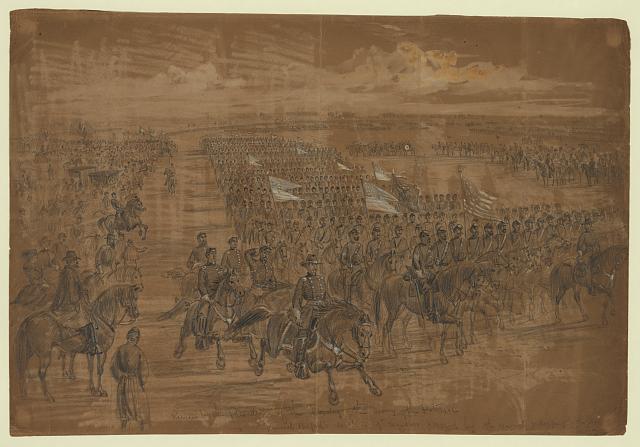
Alfred Waud depicted the opening moments of the review as Gen. John Buford, with his staff officers trailing him, led the Reserve Brigade past the presidential party. Waud’s depiction is stunning in scope. Still, in seeking to depict the size and spirit of the review, Waud compressed the column and eliminated many of the officers, buglers, and other details from the scene. He does, however, give his viewers a good idea of how a mounted force, formed in column of squadrons would have appeared.
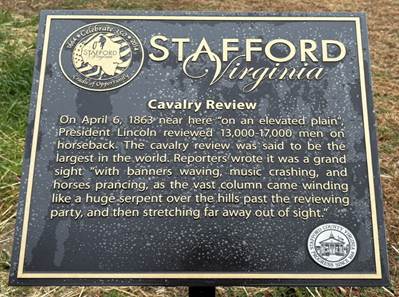
Two markers may be found in the general area of the site today. One, referring to the cavalry review, may be found near the entrance to Dixon-Smith Middle School on Deacon Road.
The second refers to the infantry review on April 8 and may be found near the entrance to Grafton Village Elementary School on Deacon Road. The two schools stand next to each other.
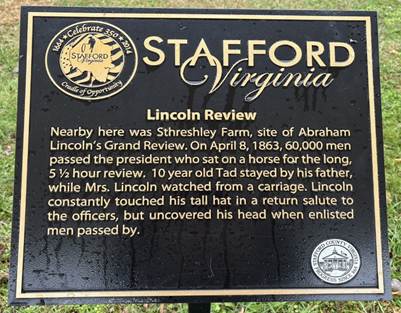
In the interest of fairness to the infantry, I include the orders for the April 8 infantry review, issued by General Hooker.
“The 2nd Corps, Maj. Gen’l Couch, 6th Corps, Maj. Gen’l Sedgwick, 5th Corps, Maj. Gen. Meade, 3rd Corps, Maj. Gen. Sickles with the reserve artillery will be reviewed tomorrow, Wednesday, April 8 at 11 a.m. by his Excellency the President of the United States.
“The Corps mentioned will assemble upon the ground indicated upon the diagram annexed.
“The order of formation of the Corps will be in three lines of Divisions. The Division formation will be in line of battalions in mass, right in front with close intervals.
“The Corps will pass in the following order:
“1st the Reserve Artillery
2nd the 6th Corps, Maj. Gen’l Sedgwick
3rd the 2nd Corps, Maj. Gen’l Sedgwick
4th the 5th Corps, Maj. Gen’l Meade
5th the 3rd Corps, Maj. Gen’l Sickles
“The troops will pass at quick time, all officers saluting. The troops will carry 40 rounds of ammunition in their cartridge boxes.
“In approaching the reviewing officer, each battalion will be required to take the double quick and keep it for a quarter of a mile, the Brigades of Divisions moving to the right and left alternately and not changing the formation from masses to lines or columns until sufficiently out of the way to render it impossible to delay the troops following in rear.
“The troops must not be allowed to halt after passing the reviewing personage and all commanders will use the utmost exertions to prevent the possibility of the stoppage of the column passing in review.
“The locations of the Divisions of Corps will be indicated by poles bearing the Corps badge.
“The Corps must be in position by 11a.m.
“The Comd’g Officer of the Cavalry Corps will detail 4 squadrons of cavalry to keep the ground clear for the passage of the troops.
“The cavalry will report to the Chief of Staff.”
The diagram mentioned has not been found, though it might prove extremely helpful in determining exactly where the event took place.
My focus here is the orders for the reviews, which many may not have seen before. For deeper discussions as to the locations of the events, I offer the following links. The Mysteries and Conundrums Blog, though no longer active, is still available online and a wonderful resource.
Soldiers’ Huts to Luxury Homes – Bell-Air Today | Mysteries & Conundrums
My thanks to both Andy German and John Hennessy for their help.
Sources:
Documents from the National Archives
The New York Tribune
The online sites listed above
Albert Conner, Jr., and Chris Mackowski, Seizing Destiny, The Army of the Potomac’s “Valley Forge” and the Civil War Winter that saved the Union.
 Small But Important Riots
Merry Christmas ! and thanks for sharing. I have an original page from Harper’s of the Waud sketch featuring Buford leading his troopers for Lincoln.
LikeLike
You hear about these things but you never think about what goes into them. Those staff officers really deserve some appreciation.
LikeLike
Hope you are enjoying the holiday season. Staff officers are under appreciated and largely lost to history. Col Doug Douds, an instructor at the War College and a Licensed Guide at Gettysburg, recently did his PhD thesis on Meade’s staff at Gettysburg, or maybe he looked at both Meade’s and Lee’s. He is a very good speaker, and you can find some of his talks on the topic on YouTube or the Gettysburg Foundation site. I hope he will turn his thesis into a book.
LikeLike
I hope he gets the proper encouragement. That’s a book I’d like to read. Along those lines, I found an article titled “A Litany of Incompetence – Staff, Headquarters, and the Civil War” (with a subheading of “… I cannot have my orders carried out!” Robert E Lee) that claims that Napoleon had more staff officers in a division than Lee did in his entire army at Gettysburg.
LikeLike
I remember reading that article, Larry. I thought I might have a copy still but don’t find it. It is amazing what they accomplished with such small staff contingents, especially remembering they had no instant communications. Behave yourself there tonight and Happy New Year Small But Important RiotsSmall but Important Riots : Nebraska Press (unl.edu)
LikeLike
Thanks, Bob, for another interesting article. I have added some information from a letter I found in a pension file at the National Archives. You never know what you will find when you look in a soldier’s pension file.
Sgt. A. E. Howard of Co. K of the 123rd NY wrote the following letter to his parents on April 15th, 1863:
Abe to has been the past week reviewing the Army of the Potomac before it starts on its summer campaign. He reviewed our Corps [12th] which numbered about 30,000, and I tell you it was a grand affair. We assembled on a large field and waited a long time for the approach of the royal family. The first appearance was a body of lancers coming at full speed, which told of the approach of the president of the United States, they were the advance guard, soon came a large covered carriage well guarded with the President, Wife, 2 sons and some of his cabinet. He then mounted a nice horse – and rode through the different Brig[ades] in the Corps with his hat off. After that he returned to his carriage. During this time the artillery thundered forth its salute of 21 guns, we then passed his carriage in column. The mighty columns moved on followed by the rumbling artillery and cavalry. The sight was grand – 30,000 Bayonets sparkling like so many diamonds in the beautiful sun light of a lovely spring day. Abe is a large coarse featured man and he looks care-worn and in fact he looks like his pictures that you have you have seen so often.
Sgt. Howard died on May 28th, 1863, of wounds received while in action at Chancellorsville on May 3rd. His letter can be found in his pension file at the National Archives.
LikeLike
Bob,
Thank you very much for adding your great find.
LikeLike